How to Organize When You're Not Good at It
A review of Love Rebels: How I Learned to Burn Things Down Without Burning Out

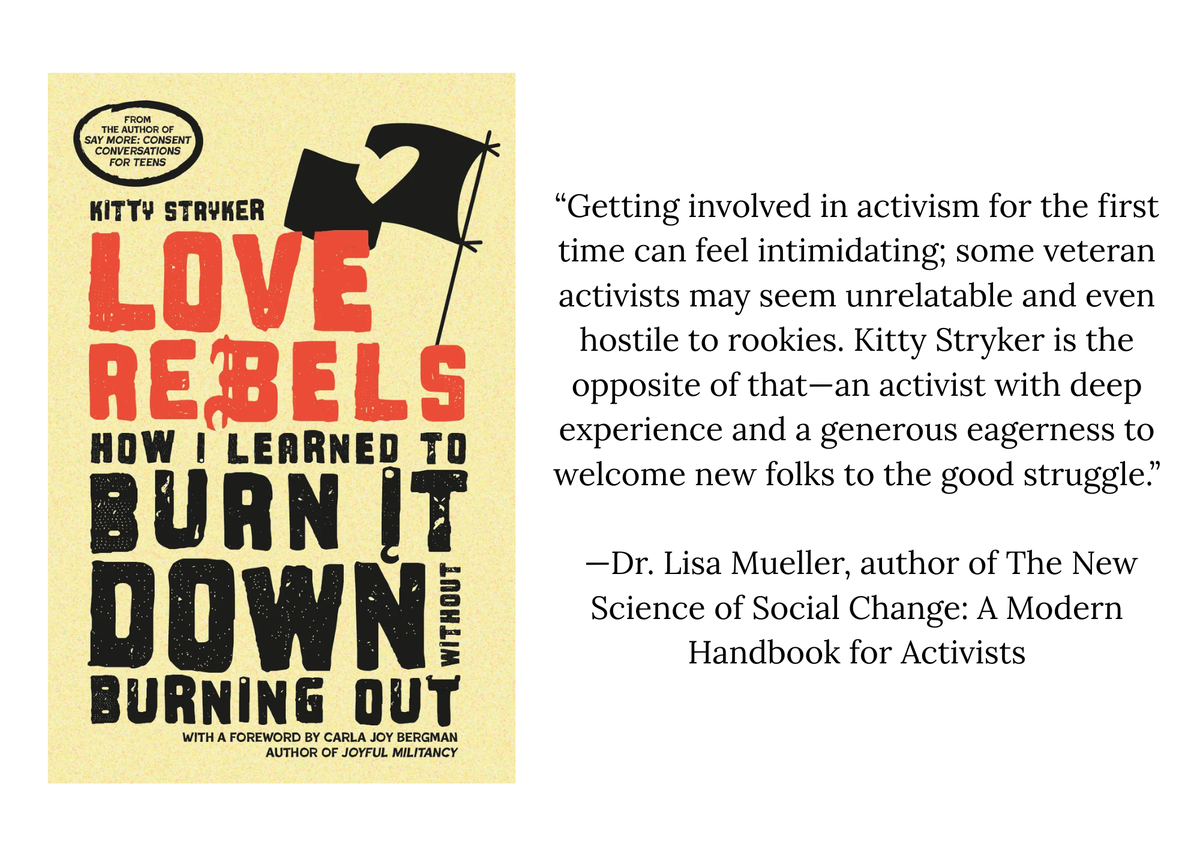
When activist Kitty Stryker skeeted her new book was coming out and she was seeking advance readers to provide reviews, I jumped. It had been about five months since Hurricane Helene. Piles of debris still sat in the roads, waiting to be removed. Contractors were repairing roofs and fences and other structural damage.
And the Department of "Governmental Efficiency" was tearing through federal agencies like FEMA the way wildfires would through our nearby foothills in forthcoming weeks.
I knew I wanted to do something in emergency management, but I wasn't sure what, or how. Formulating a career in the field seemed like a better fit for me than traditional activism, which, having grown up a "good girl," I'd never been able to figure out how to fit into my existing life.
Sure, I'd brought my sons to a handful of protests when they were old enough to understand and not complain about being cold or hungry five minutes after getting there. We weren't a constant presence, though, at every rally or protest. Crowds feel overwhelming to my neurodivergent brain. When I could, I'd attend things like postcard parties, hoping to forge deeper connections in quieter settings that would bring me deeper into kinds of activism that felt more "me."
I soon found, though, that it is in fact harder to form friendships in adulthood. Plus, the idea of passionate and sustained direct action, however introverted postcard-writing might be, felt as exhausting and inauthentic to me as the idea of weekly protesting.
Worse, trying to form an association with an established group post-divorce, I found my newly scabbed-over interpersonal wounds far too easy to tear open and bleed all over everyone else. I found I couldn't distinguish safe from unsafe people, so I didn't feel I could trust anyone to help me discover what I had to offer.
I wasn't burned out, but I was uncertain. I really wanted a new perspective on how to show up. That meant Stryker had written for me, too.
I didn't actually read Love Rebels: How I Learned to Burn It Down Without Burning Out for another few months. When I did, though, I found the book delivered, and in a way that made me feel deeply seen.
A book that "is focused on the balancing act of being engaged without burning out," Love Rebels is arranged into chapters that start with the one-on-one interpersonal relationships (including the one with ourself) underlying activism, to organizational concepts like working with leadership structures and forming and maintaining coalitions.
"I picked the name “Love Rebels” because I liked the multiple meanings. I liked the idea of it as a noun, being a “love rebel”, someone who pushes against the easy categorization of what love means, and who love is for. I liked the idea of it as a suggestion, that we should perhaps “love rebels” by having curiosity and compassion for people who are against the status quo. Finally, I liked the idea of it as a verb, “love rebels”, that choosing love can be inherently rebellious at its core in a world that seeks for us to separate ourselves into walled gardens. This is hard work, but I truly believe it’s worthy work." – Kitty Stryker
Reflecting on the impact of trauma on my involvement
Stryker's perspective is as trauma-informed as it gets, because she's lived it. Every paragraph underscores her understanding of the extent to which interpersonal dynamics can complicate activism on both individual and community levels. To that end, her writing has a way of crystallizing various ways in which my own struggles have constrained my involvement. In Chapter 2, she writes:
"One of the most important things I have done to improve my relationships with others, educate myself on perspectives I don’t share, and take a much-needed step away from a rescuer mentality, was to quietly and consistently participate in activism groups where I was the minority. By showing up and listening more than I talk, I strive to decenter myself and my identity in the activism I participate in."
I found myself realizing that in previous activist attempts, I didn't want to decenter myself because I had already felt decentered enough as it was in previous relationships. Relegated to back corners and side panels in my own life and career, I'd learned that speaking up was simply not welcome.
While I didn't consider myself one of those activists who wants a cookie just for showing up (for one thing, I'm gluten-, dairy-, and sugar-free), I also recognized I sought acknowledgment for caring. A warm smile, a quick off-hand conversation, the sense of connection I've never felt.
Writing about protests and their after-effects, for example, Stryker wrote of the potential need to ask others to check in following an event. In the wake of my divorce, I've been especially intrigued by the concept of mutual aid, which Stryker defines as "when people take care of each other on a community basis, sharing resources and services voluntarily, with a core value of solidarity with each other and reciprocity when we have it to offer."
I was especially thrilled to see Stryker include disaster response and emergency management in her definition of community activism. "Being in a city, my neighbors' preparedness in a disaster or lack thereof is deeply connected to my own – we rise or fall together, to some extent, especially if we’re in the same building or block!" she writes.
"Taking a small town neighborly approach to urban living felt like a necessity, especially as I witnessed what happened in other disasters like Hurricane Helene or the wildfires in Northern California. I didn’t want to wait to build that safety web for when we were all struggling."
Nor do I, and yet, even in "blue sky" times, I find myself struggling anyway. In my neighborhood, as I've written, everyone more or less keeps to ourselves. Although I have a couple of "weak ties" nearby, I've started to look more into local opportunities to build a community network based on Stryker's advice in Chapter 6: asking the question, “What is my personal skill set?”
Reflecting on how to show up
Personal causes and special interests, hobbies, and "areas of nerdy curiosity" help to refine how you shape your activism. Knowing what you're good at and not so good at, what you're able to do and have less capacity for, is how you meter your energy when you're also navigating all those interpersonal relationships and the potential landmines they set.
Indeed, the last part of the equation is what groups and resources already exist in your physical or emotional communities. "Where can I pitch in? What could I utilize and network?" Stryker asks.
"When figuring out what kind of activism you want to do, I recommend starting small and building from there. It’s so much more powerful (and sustainable) to show up consistently and to be reliable than to offer too much of yourself and then need to take a long time recovering and out of service.... Whether you create an activist opportunity wholecloth, or plug into one that’s connected to your day-to-day life, whether you have a lot of experience or none, many paths are available to find your footing as an activist."
Of course, figuring out what to do is only one aspect of activism. Just as important is figuring out whom to act alongside. Stryker spends considerable time discussing interpersonal relationships. The setting and maintenance of boundaries, power dynamics, accountability, and even toxicity and abuse are all discussed. Stryker writes:
"It can feel really difficult to know what to do or how to act, especially as different marginalized groups express disparate and sometimes contradictory pleas for action (and especially when those actions are equally valid responses to injustice!). I am constantly made aware that the world we live in is a complex and often paradoxical place, where nuance is everywhere and simple answers are rare."
Of course, people are the wild card. In one example of the kind of nuance she's talking about, Stryker in Chapter 9 quotes Jo Freeman from The Tyranny of Structurelessness:
"Thus structurelessness becomes a way of masking power, and within the women's movement is usually most strongly advocated by those who are the most powerful (whether they are conscious of their power or not). As long as the structure of the group is informal, the rules of how decisions are made are known only to a few and awareness of power is limited to those who know the rules."
The quote echoes my experience trying to "go along to get along" within the informal social structures of school grounds and workplace break rooms. So when it comes to building coalitions across ideologies, for which Stryker advocates strongly, building leadership skills is crucial whether or not your leadership is formalized.
Reflecting on how to step up
Chapter 10 outlines several different kinds of leaders, each with their own advantages and disadvantages. Stryker is careful to note: "I feel like no one of these strategies works 100% of the time, and instead, you may find yourself straddling a couple, or trying more than one before settling mostly into a particular style."
In fact, I found myself holding each kind of leadership up to the Incident Command System structure, which feels like a mix of collaborative and democratic styles at its core.
In fact, in her Chapter 11 description of organizing, Stryker recommends doing so around an objective – exactly what a standard ICS does, including making SMART objectives: specific, measurable, achievable, relevant, and time-specific.
(Other aspects parallel to the ICS, including a financial agreement, plans for leadership, accountability, and communications, and logistics also matter for organizing in Stryker's view.)
Healing ourselves and our communities
Overall, Stryker's writing makes me want to sit down with her in person to talk about all sorts of things, and indeed, in her introduction, she writes:
"It is not intended to be a foolproof guidebook that will help you have perfect success in every activist coalition and personal relationship. My hope, rather, is that 'Love Rebels' will serve as a comfort and a friend when you feel stressed and confused. This is like me listening to you over the phone when you feel like you’re about to burn out. I want this to feel like a friend who has been through it too, giving your shoulder a squeeze and saying, 'hey, it’s ok, you’re not alone'."
But Stryker has no idea who I am other than someone who reached out to ask for an advance reader copy of her book, so that phone call is probably not going to happen anytime soon... and if I'm honest, as a baby activist and someone who is still healing from codependent relationship patterns, I actually prefer to engage with the journal prompts at the end of each of her 12 chapters. Rather than seek her validation for my ideas, I can solidify my own values and seek validation that way – a necessary part of my healing.
Still, healing cannot happen without community; without the relationships we need to test the lessons we've learned. "When our government and our media encourage us to be suspicious of our neighbors, especially if we’re different from each other, it is a radical act to refuse that fear," Stryker writes. "Our willingness to engage, and even to disagree, helps us be better, more rounded activists in our own spheres, even if our methodologies differ."
This is a book both for those who are burned out, and for those who are afraid of burning out. In that way, it was everything I hoped it would be and then some: I came away with hope that I can find a way to contribute that fits me and who I am and how I'm still healing – one of the most important takeaways of all for our age.


