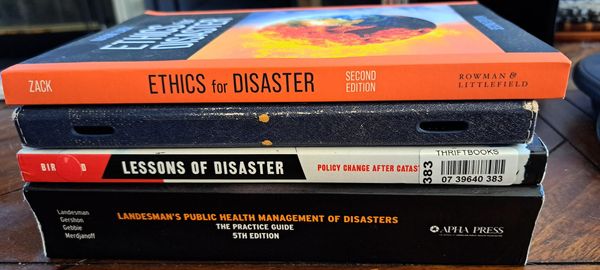
My First Graduate Class Was a Success. I Still Don't Have a Clear Path
My career has been an endless series of pivots made in survival mode. Emergency management may be no different


Last weekend, I turned in my final discussion post for my first graduate class, Natural Hazards & Human Risk Factors. I can't say I'm glad it's over. Although it sucked up the little bit of free time I had in the evenings and on weekends, a) that's what you expect from graduate classes and b) at least it was manageable from week to week.
The learning, moreover, was, well, fun. In processing new-to-me information about plate tectonics and atmospheric processes, earthquakes, landslides, subsidence, storms, and wildfires – along with the fundamentals of human geography – I found myself leaning on long-forgotten 9th grade earth science, as well as on state and local hazard mitigation plans and floodplain management strategies, among other resources.
I wrote, too. Not a lot (by my old standards, anyway), but enough. Putting together my takeaways from weekly reading assignments on both human geography and natural hazards, I wrote responses to chapters and to my classmates' responses. I wrote two term papers, both focusing on the Philippines; one on three recent earthquakes, the other on the typhoons that went with them last fall.
I focused on contributing without overextending myself. I allowed and even embraced imperfection. I fell in love with learning again, and with writing about it.
But do I foresee a career as a hazard mitigation specialist, or as a recovery coordinator, or continuity manager? I'm not so sure.
There's burnout. Then there's burning away
Much as I've enjoyed being back in school – the one thing in my life that felt like it was actually going truly, unmistakeably right – I am, after all, still recovering from burnout. Only a year ago I thought I might never write again, and I was perfectly okay with that.
By now, burnout is woven into my life – jobs, marriage, motherhood – like a pattern stitched through a loom no one realized was already warped.
I believe much of this was the result of undiagnosed neurodivergence, which I described some of in my freelance colleague Sam Dunsiger's article at their Substack,The Breakroom Dispatch. Yet, even after my ADHD diagnosis, I couldn't understand how an activity I loved – writing – could burn me out.
Of course, now I can recognize the endless masking I was engaging in, part of an effort to mold myself into the perfect representation of the potential I always heard I had, but, as implied, wasn't quite meeting. That was why none of my titles – "contributing editor," "author," product marketing manager," "managing editor," and so forth – ever felt like they fit.
It was no great loss when the hardships of the last five years burned all the masks away – along with the energy I was wasting trying to sustain them.
Just as it's been hard to separate perfectionism from my writing process, though, I've found it hard to separate masking from my work life. So, although I went back to school for the same reasons I initially started training with the state emergency management division – to meet other professionals and network – that process has been slow going.
Of course it has; we're all busy with our day to day jobs and lives. The work of figuring out where a new person fits in is extra, on either end. Add in neurodivergence and trauma healing, though, and the process slows even more – slower than I'd like, given the rise in cost of living that feels farther and faster than my income can absorb.
In midlife, the prospects of starting a new career over again are... challenging. Unlike people who are just starting out, those of us starting over might be choosier. We've had the jobs that killed our souls, the toxic work cultures, the amazing work environments we wanted to stay in forever (that changed along with a manager's departure, or a surprise layoff). Because those experiences involved trusting and even upholding others' illusions, we're now much less inclined to do so.
Our inclinations make us harder to mold than younger, less experienced graduate students or degree-holders. We know what we find meaningful, and we can see through the nonsense that tries to convince us that we can find meaning anywhere, if we only try hard enough to see it.
Studying trauma healing, while healing trauma
I'm in the same liminal space now that I expect many people are after a disaster. Following that fire or flood or windstorm or landslide that wipes out what you've spent your whole life building, you want to know "Now what?" Some people rebuild. Others move far away. Some people can't cope and fall into ruin. Others rise up and shine.
I picked a degree program in trauma-informed emergency management for these reasons. How people prepare for, respond to, and recover from disasters is often driven by the traumas they've experienced and the impact to their sense of self – their sense of capability, even worthiness.
Yet, as I wrote recently to a classmate offering her perspective on mental health in disaster: of all of FEMA's Community Lifelines, not a single one mentions mental healthcare. ("Crisis counseling" gets a brief mention under Emergency Support Function #6 – Mass Care, Emergency Assistance, Temporary Housing, and Human Services. While the ESFs roughly map to the Community Lifelines, neither prioritizes mental health. And that was before the recent cuts and other changes to FEMA.)
It's apparent to me that the current system is built to manage people's immediate needs, the logistics and supplies that are a lot easier to procure and manage than, say, temporary shelter from your damaged home and your abusive family member and that's accessible for your lifelong – or newly diagnosed – disability, or therapy that can help you process the disaster, last month's layoff, last year's divorce, the previous year's job loss, and the deaths of loved ones the year before that.
Put another way, at the present moment, pursuing a standard career with yet more titles feels a little too much like the version of me that lived to meet others' standards set, of course, by their own masks and illusions.
Maybe, just one class in, I'm once again putting too much pressure on myself to have it already figured out. But maybe, although it feels like the economy isn't leaving much room for the privilege of figuring out how I want to spend my remaining working years, that's exactly what I'm meant to do, because it doesn't look like what's already been built.
Join me to learn as I go. You might learn something too.