The Groups We Trust, the Crowds We Don't
How we define a "mob" has everything to do with response to regional and national emergencies


I'm finding it difficult to string words together this week, following the events in Minneapolis this week. As I skeeted on Bluesky:
"Part of my challenge is that the site (per its tagline) is about learning emergency management after personal disaster &... [Renee Nicole] Good's murder highlights that intersection. A child has lost his mother, a wife her partner, friends and loved ones... as part of this slow rolling disaster of current events."
In case it wasn't already clear from my previous posts about FEMA funding and other resources, I believe our current moment is an ongoing national emergency as US fascism tries to regain the chokehold it was denied nearly 100 years ago.
Our national emergency is composed of so many personal emergencies, from mass layoffs and unemployment lasting months, to detainment and deportation, to the repercussions of street and school violence including ICE actions of late.
These emergencies are manufactured to scatter and isolate us; to make us turn away from one another and focus on getting through our personal day to day.
To be clear, I believe there is value in finding your footing after you've been destabilized. It's all too easy to distract yourself from your own reality by finding comfort in, say, a romantic relationship or bottles of pills and/or alcohol or game consoles or, for that matter, creating an entirely new identity around a cause.
By contrast, isolating so you can learn who you are apart from those comforts or your previous identity anchors is hard, scary work. It's truly staring into the abyss, realizing the abyss is part of you, and making friends with the emptiness... sometimes even as friends you thought you could count on turn and walk the other way.
Choosing how to show up in spite of it all is the test.
To that end, I want to focus this post on the power of collective action: response and recovery, grief and growth, being and building.
Do we lose ourselves, or find ourselves, in groups?
When I was reading A Paradise Built in Hell, one of the things that particularly struck me was the way author Rebecca Solnit challenged and even deconstructed a fundamental aspect of government-led emergency management training: the nature of crowds.
Early in my career exploration I had taken the independent study course "Special Events Contingency Planning for Public Safety Agencies." Because I work a fair number of large special events drawing many thousands of people, I thought it would be wise to learn how agencies plan for crowds – such as designing for pedestrian throughput into and out of event space, both under normal circumstances and in the event of an emergency – with regard to the natural, technological, and human hazards that could complicate events.
A wide range of factors are involved in contingency planning. They include:
- how likely a hazard is to occur, based on historical and statistical data including any seasonal patterns
- possible frequency, duration, and magnitude
- speed of onset and warning availability
- location / jurisdiction / geographic characteristics / property and infrastructure / probable spatial extent
- vulnerabilities including trained and equipped personnel
- area and crowd demographics
The course stated that crowd behavior could be associated with catalysts like the tedium of waiting, the perception of being "last," etc. all contributing to "deindividualization," or in other words, people acting like a school of fish or a flock of birds, moving as one rather than making individual rational decisions.
This view is arguably the result of the 1895 book The Crowd: A Study of the Popular Mind, authored by Gustave Le Bon. The French psychologist, sociologist, and anthropologist also held some questionable views on race, so its assertion that (in Solnit's words) "when individuals gather, they lose themselves and are swept along by primordial forces" might have also influenced the way authorities approach certain crowds.
"The basic notion is of people so overwhelmed by fear and selfish desire to survive that their judgment, their social bonds, even their humanity are overwhelmed, and that this can happen almost instantly when things go wrong—the old notion of reversion to brute nature, though out of fear rather than inherent malice."– Rebecca Solnit
"Le Bon’s argument was that instead the crowd itself produced a form of irresponsible madness, a whole far worse than the sum of its parts." In turn, Solnit continued, belief in "panic as extreme and unreasonable fear and flight behavior... provides a premise for treating the public as a problem to be shut out or controlled by the military."
Further, she stated, "To believe this is to believe that the very act of agglomerating into groups makes humans go mad and that the public is inherently dangerous," a problem evidenced by the way disaster funding is structured to "prevent people from panicking or engaging in antisocial behavior."
What Le Bon might have thought of the argument for the wisdom of crowds would have been interesting indeed. For Solnit's part, "... what can look chaotic from outside—people moving as fast as they can in all directions—is often the most reasonable response to an urgent threat."
Likewise the phenomenon of "looting," "an inflammatory, inexact word that... pools together two very different activities," Solnit wrote. "One might be called theft; the other requisitioning, the gathering of necessary goods in an emergency," especially as "extreme poverty and social inequality made theft a quick and readily available form of mitigation in the upside-down world of disaster."
In fact, she later observed: "Many would not consider property crimes significant when lives are at stake—and the term looting conflates the emergency requisitioning of supplies in a crisis without a cash economy with opportunistic stealing."
Why our perception of crowds matters
It's easy to buy into the idea of dangerous, violent mobs not just because we've all seen media coverage of, say peaceful protests turned violent; but also because many people have personally experienced the dangers of groupthink: according to Wikipedia, "a psychological phenomenon that occurs within a group of people in which the desire for harmony or conformity in the group results in an irrational or dysfunctional decision-making outcome."
As early as in schoolyards, kids gang up on other kids they perceive as weaker or weird; "not one of us." Family and social systems band behind abusers, not survivors who speak up. And we all know what happens in a workplace (or government agency) when its workers try to think for themselves.
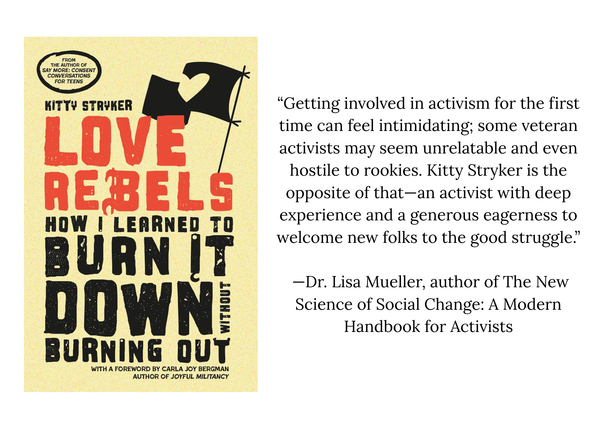
Even protests, "a uniquely exhilarating and exhausting experience," as Kitty Stryker wrote in her book Love Rebels, can mirror traumatic experiences. "I also know that I’m a person who disassociates in a crisis, which makes me calm during an action, but I have a bit of a breakdown a day or so afterward," Stryker wrote.
Solnit summed up perhaps a broad human approach to all organization when she wrote: "The premise was that people were sheep, except when they were wolves, and the solution was to find out how best to herd them."
In modern emergency management, she stated later, "best" is the command and control model. She concluded: "The effectiveness of disaster response is thus diminished to the degree that we overrely on command and control."
Community responders need organization, but do organizations need community responders?
I have mixed feelings about whether modern disaster response is "overreliant" on command and control. On the one hand, Solnit's observations about the 1906 San Francisco earthquake and the 2005 response to Hurricane Katrina paint a picture of government authorities who were less interested in the "dazed and helpless mass completely dependent on outside aid for guidance and organization" than in being bent on maintaining order.
"In treating the citizens as enemies, the occupying armies drove residents and volunteers away from scenes where fire could be prevented," wrote Solnit of San Francisco, though her words could as easily have been applied to the armed troops who responded to New Orleans nearly a century later... and to cities like Los Angeles, Chicago, Portland, and Minneapolis most recently.
Solnit's argument was that people are perfectly capable of organizing themselves to provide community care. She pointed to the firefighting bucket brigades and community kitchens of San Francisco, along with the "spontaneously assembled collection sites, commissaries, and supply chains" that supported Ground Zero workers in the days and weeks following 9/11.
Yet in classroom courses I later took through the state emergency management office, multiple instructors would insist that "self deployment" of volunteers was to be avoided. People who wanted to help, they said, needed to register through a Voluntary Organization Active in Disaster (VOAD) and follow check-in / check-out protocols among others, to properly account for people's presence and safety. Otherwise, the untrained public could jeopardize themselves, professional responders, and the overall operation.
I think there's some truth to this. Since 1906, a lot of science has gone into understanding various forms of hazards, along with how disasters happen and how to predict, track, and respond to them. A well organized response apparatus is needed to effectively synthesize information streams from multiple sources; see The Atlantic's Alexandra Petri's piece on trying to function as a one-woman government.
As Petri's experiments showed, though, an apparatus is only as good as its resources. FEMA's response in my region was still met with a lot of suspicion and derision, possibly stemming from being denied the natural inclination towards community and what Solnit called "collective solutions—community kitchens, emergency shelters, bucket brigades."
Perhaps what my neighbors resisted was, in Solnit's words, "'Pauperization,' the transformation of independent citizens into dependents."
On the other hand, I already personally felt pretty dazed and helpless in the immediate aftermath of Hurricane Helene, as I observed the extent of the destruction and wondered how I would manage the little bit of it in my yard. I was grateful for the guidance and organization that weeded out unscrupulous contractors and other actors, funded the replacement of my lost groceries, and restored traffic signals along with roadways in short order.
Then again, I'm a white woman, and there were no troops in my (relatively white) corner of the Southeast. Most people seemed to rely on their churches (arguably an alternative form of social control). And it is true that while the command-and-control model might have limited unscrupulous independent contractor activity, it is less effective against systemic cronyism such as, as Solnit wrote, "the contracts that paid exorbitant sums to major corporations for tasks like putting tarps on damaged [New Orleans] roofs."
Can our projections teach us more about our own unmet needs – and how to get them met?
A popular meme today, "Every accusation is a confession," echoes Solnit's words when she wrote, "Those in power themselves are often capable of being as savage and self-serving as the mobs of their worst fears," or in other words, "...elite panic comes from powerful people who see all humanity in their own image."
Notably, the 1906 earthquake happened during the period of time in which socialism and communism had become a popular backlash to the exploitation inherent in the Industrial Revolution. “Elites fear disruption of the social order, challenges to their legitimacy," Solnit wrote.
To that end, she observed, "[The elite] also believe that they are preventing crime when they commit it" -- whether armed Algiers Point whites shooting Black survivors crossing the bridge from the Lower Ninth Ward, or ICE shock troops shooting unarmed civilians in the face.
"Is social breakdown when thieves proliferate? Or when people are willing to kill those suspected of property crimes? Or when the most vulnerable are left to die? Or the most powerful prevent aid and evacuation?" Solnit asked, arguing, "...in disaster we need an open society based on trust in which people are free to exercise their capacities for improvisation, altruism, and solidarity."
If we, like the elites Solnit wrote of, only see weakness and moral decay in our neighbors, it only reflects what our own individualism has made of ourselves. In our isolation we struggle to meet our own needs, and can only assume others, similarly afflicted, would drain what scarce resources we have left.
We might stop to consider that banding together strengthens us by shoring up what we lack. FEMA's organization of local contractors meant that one of my neighbors could cut up my fallen tree, while another came by to dig out the stump.
Solnit wrote of a certain nostalgia felt by many Poles "...not for the Communist regime that fell in 1989 but for the close-knit communities that developed to survive that malevolent era, circulating black-market goods and ideas, helping each other with the long food lines and other tasks of survival, banding together to survive."
Before we get to this point, we might consider whether we can come together in the name of self-actualization and social thriving rather than, once again, mere survival. I feel this acutely as an individual not long out of survival mode and wanting to contribute with more than a set of social constraints deemed acceptable for my age, race, and especially gender.
It might be too late for the socially and morally bankrupt who find themselves drawn to ICE. But it doesn't have to be too late for the rest of us.