Answering Love Rebels' Questions
Thinking more deeply about activism and myself as an activist in emergency management


In her most recent videos on politics, history professor Heather Cox Richardson has been exhorting her audience to find their "thing" and get involved. It isn't a new suggestion, and not hers alone. For at least the past decade, a "thing" could be phone banking, postcard writing, demonstrating, voter registration, and many other actions around a wide variety of issues.
These days, the issues feel overwhelming, and the actions might as well be a full-time job. To me if not others, the "thing" needs to be an issue one can specialize in, with the actions flowing organically from that knowledge.
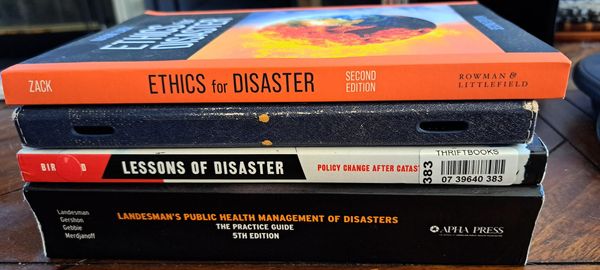
Emergency or disaster management is a "thing" not too many people consider among the economy, abortion, education, healthcare, housing, or even climate change. Yet this "thing" touches all of those and more. That's why it feels like, for me, the only logical "thing" to embrace.
At the end of my January 5 post, which reviewed the book Love Rebels: How I Learned to Burn It Down Without Burning Out, I wrote:
"... as a baby activist and someone who is still healing from codependent relationship patterns, I actually prefer to engage with the journal prompts at the end of each of her 12 chapters. Rather than seek [author Kitty Stryker's] validation for my ideas, I can solidify my own values and seek validation that way – a necessary part of my healing."
I decided it might be interesting to answer those questions publicly, though, not to seek validation but to document how I'm approaching community at this point in my life.
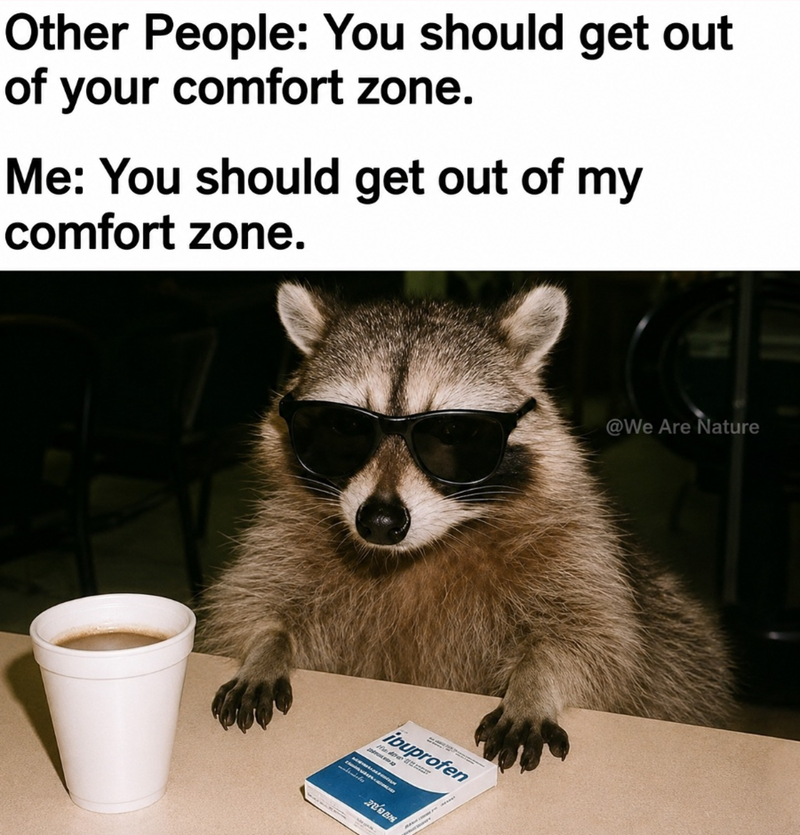
Fair warning: this is a long post, a little more than 5,000 words. It's quite a bit broken up (including by a raccoon meme a ways down!), but just as Stryker's chapters flowed one into the next, each question / set of questions builds on the last, so the answers flow too.
What made you pick up this book?
The snarky answer would be that the author sent me an advance reader copy in exchange for reviews. But the reason I responded to her skeet to begin with was that it intrigued me. I've been a spotty activist at best, never quite sure how to engage in a way that felt authentic to me – that drew on my strengths and interests, rather than wearing me out trying to act in ways that other activists prioritized.
For example, protests always feel loud and overwhelming, and I tend to dissociate in crowds. I never do make the kinds of connections I hope to, and besides, the people who are drawn to protests seem to prefer loud and visible over quiet and mindful.
Maybe that's because protests are easier for many people to fit into their schedules. You can take a couple of hours out of a Saturday afternoon or a Tuesday lunchtime to go speak your mind. And because of the sheer numbers of people at a protest, they're generally safer activities.
None of which has ever appealed to me. If I've already been working (peopling) all week, the last thing I want to do is more peopling. And yet, we're at a critical moment in history. If I'm going to sit at home introverting, I'd at least like to figure out how to make it count.
In what ways do you conduct your relationships radically?
At the moment, not at all. My relationships have always been somewhat performative, based on what I thought I should be giving (but often not receiving), again what other people prioritized, etc.
Ultimately I burned out trying to be a good wife and friend and coworker. Even as people stepped back from me, I found myself taking a big step back from all that performative effort so that I wouldn't burn out as a mother – or as a friend to myself.
In fact, that's probably the most radical relationship thing I've done in my whole life: prioritize myself and my needs in friendship. I know that makes me sound selfish, but the whole oxygen-mask thing is very, very real.
In what ways do you engage with politics radically?
For me, paying attention. For years I didn't. Because I spent so much of day to day life in survival mode, it was difficult to engage on any more than a passive level: numb and without much empathy.
Now, in keeping with befriending myself, I'm learning to figure out what I have to offer and how to offer it; how to dip my toe in but then back out when I feel overwhelmed, how to regulate and then return, how to care in a way that drives my action rather than my sense of helplessness.
More specifically, deciding on an emergency management career path has given me a structure in which to engage with politics. Lots of political positions and decisions affect how we respond to disasters and one another in them, and while I'm still feeling out how to engage, I'm finding it easier to meter my energy on a topic I'm already pursuing.
What does being a “love rebel” mean to you?
"Love" is a challenging word for me because in my past it was synonymous with "control" rather than the various Greek words and definitions (philia, agape, etc.) When I consider "rebelling," then, it's against that misuse of the term and associated actions that indicate any kind of exploitation or coercion. It's for returning to a concept of love that balances self with others and understands how deeply connected we all are to one another.
Do you know what your “lines in the sand” are?
I'm still learning them after many years of having no boundaries, because I was conditioned to believe boundaries were threatening to anyone I loved. So I guess the first one is: no more people who won't let me have boundaries. Beyond that, though: I prioritize rest and recovery. I expect to be treated like an adult with agency. And I expect reciprocity, especially when asked to contribute more than is typical.
How would you like to manifest being a “love rebel” in your life?
As I suggested in my intro, I want to pick one thing to be deeply passionate about and devote my time and attention to helping people through that, rather than spread myself thin across many causes or priorities.
I think this approach honors who I am while contributing to society, allows me to direct my energy in the most appropriate manner and most of all, heals me to the extent that my healing promotes others' healing.
What are some ways you are marginalized in your day to day life?
I'm neurodivergent, so the world is not set up for the way my brain works. I find I'm often expected to manage my time and energy in a way that fits neurotypical productivity culture, and shamed when I try to protect myself from burnout and overwhelm – or for that matter, when unchecked burnout and overwhelm cause me to dysregulate. My neurology is seen as a personal failing rather than a physical limitation.
What are some social advantages you have?
I'm a white, cisgender, heterosexual woman. I'm relatively thin and attractive for my age – meaning I look substantially younger than I am. I grew up middle class and still approach life as if I am. And I'm healthy and fairly physically fit.
What is a situation where you noticed a power imbalance in your life that benefitted you? Did you acknowledge and address it, and if so, how?
Probably the best example is the adult/child imbalance I've experienced both as a mother and anytime I've ever been around children, particularly in a situation where I was asked to believe either a child's version of events, or an adult's version. I've found that kids are smarter than adults often give them credit for, and at one time I was the "kid with quite the imagination," so I try always to listen first and be as careful with kids' feelings and points of view as I am with other adults'.
What is a situation where you noticed a power imbalance in your life that had a negative impact on you? Did you feel safe bringing it up? Why or why not?
My entire life feels like it's consisted of these situations, and I've hardly ever felt safe bringing it up. To use an example from my own healing process, though, I noticed my new-to-management supervisor using language and tone that triggered my trauma. I felt safe enough to engage, including to make a plan for what I would do if it went south. But I found even after engaging and taking initial steps to resolve the issue, I still felt triggered regarding potential future consequences.
What are some methods of self-care you have found especially centering in your life?
A morning cup of green tea helps me focus for the rest of the day. Likewise a yoga practice, though I've noticed I tend to associate yoga more with workdays than days off and tend to skip it on days off. Making time for journaling helps slow my brain down long enough to process things. And soaking in salt baths helps take the edge off tough days or weeks while helping me feel I'm releasing stress.
What fills your cup?
I love journaling or working on articles while I'm listening to jazz. I feel most like me when I'm doing this, like it's the life I always envisioned for myself. Completing yard or house projects helps give me a sense of accomplishment, tangible results. Paddling a quiet lake or hiking near water bring me peace.
Is there an example of something you used to do as part of your self-care routine that doesn’t serve you anymore?
Many forms of self care for me have ended up ultimately being forms of self-sabotage, so for example, binge watching TV and movies (often while I was writing; they distracted me and prevented me from really sinking into my work), or "rewarding" myself with chocolate or other brain-fogging foods. Sabotage also involves avoiding self-care that does serve me, like a daily morning yoga practice.
How do you balance taking care of yourself with activism right now – what would you like to improve, and where do you think you’re getting it right?
At this moment of my life, I'm putting more into self care than activism because after a lifetime of putting others and their priorities first, I need to learn how to lavish care on myself.
The result is that I'm taking activism very slowly, easing my way back into writing and engaging on social media. Ultimately I know I need more education and practical experience to engage meaningfully on emergency management, so I'm going small step by small step toward that field as my cause of choice.
What are some ways you can make more room for pleasure and ease in your life? How about in your community?
I feel very conflicted about making more room for pleasure and ease because of how limited my income is. It's hard to spend money on cultivating those qualities, e.g. in a coffee shop or purchasing hiking or paddling equipment. I also end up working a lot, so there's limited time for long woodland hikes, for example.
I do try to find pleasure and ease in my working environments. I try to take on paid work that I find enjoyable and doesn't require a lot of effort; where I can find pleasure and ease in watching birds or reading during quiet hours or even driving around my city in the course of my responsibilities, even though I'm at work.
Ultimately I'd like to try and find volunteer opportunities that achieve the same degree of rest without feeling like another form of overextension.
What members of your family have you felt comfortable talking about politics with, if any?
I can mostly talk with my sons about politics, though sometimes they just sound like they're regurgitating talking points from a family member I'd rather not feel is still in the room.
What types of community mutual aid or other activism could you come together on?
In the past, we've attended protests together as well as river cleanups and one postcard party. But they're at the point in their lives where as young men, they're finding their own pathways in their own communities of friends and school and work. I would certainly join them if invited, but am feeling like we're all trying to find our own ways as they necessarily separate from me.
What about members of your family with whom activism or politics have been a point of tension?
My uncles and aunt seem to be more conservative than I am, and we don't really talk politics; also because we're only just now starting to come back into sync with one another after many years of estrangement.
Can you think of some creative ways you could work together on a project that you can all agree on?
We are pretty far-flung and tend to spend the time we do have catching up with each other, but I think it's a form of community-building and healing the world needs just as much from an energetic standpoint – healing rifts caused by misunderstanding or simple perceived misunderstanding.
In the case of family members who are not attuned with your viewpoints, what are some healthy boundaries you could outline and enforce when they push back against your activism?
I think I would simply say that my views are grounded in my experience, and I respect that theirs are likewise. No one has all the answers and I think I would simply leave it at that. However, I might also ask them about what kinds of activism their views lead them to engage in, and why they chose it – dialogue and curiosity over dissent and judgment.
Think back to a time someone told you that you hurt them. How did you react?
Not well. Like anyone, I didn't want to believe I could be a bad guy, and I got defensive.
Why do you think you reacted that way?
My nervous system interpreted their feedback as an attempt to control the way I show up. In my past, criticism, even if delivered "constructively," was often weaponized to shame me into acting or relating in ways other people believed was "acceptable" versus leaving room for my personhood. So for example, I was "talking back" or "making excuses" rather than merely asking questions / providing reasoning or obediently doing as I was told.
How would you like to react if it happened today?
I would apologize and ask how I could do better next time, but I also I would ask for the grace to not be expected to be perfect. I'm still healing, things like emotional regulation are still hard, and I'm going to be messy.
Have you had an experience where someone you cared about needed to be accountable for harm?
Yes, but the system thought merely getting caught was accountability enough, and true accountability never happened.
Did you speak to them about it? Why or why not?
No. I felt far too threatened to take it up with them. They already had a history of fighting dirty, deflecting and projecting back on me. I had long since realized it wasn't worth addressing harm directly with them.
Would you do anything differently now?
I don't think so. I could've fought harder, but at that time my nervous system was a wreck. I was very much in survival mode and it was all I could do to get through each day without trying to add to my stress.
What are some ways you feel drawn to “plug in” to your community as an activist?
I still feel I can best contribute through writing, but I also feel like I'd be happy in a community garden and/or kitchen, growing and preparing food, as long as the space didn't get too crowded. Likewise river cleanups, on the shore or (preferably) in a kayak.
Have you tried a type of activism in the past that didn’t work for you?
Yes; protesting and postcard parties. I've also participating in seed packing for the county library system.
Why do you think it wasn’t a good fit?
Protesting and seed packing ended up being too crowded and noisy, overwhelming my senses and social battery, even though protesting in particular felt exhilarating in the moment. Plus, with protests, over time I found myself anxious about the possibility of being arrested or assaulted, especially after I became a single mother.
Postcard parties were more intimate, but I found I really wanted to form deep communities and friendships rather than "weak ties" work, and even in that more introverted environment I found the activity didn't lead that way, probably because the other postcard writers already had enough friends and family.
What was a better fit?
I really enjoyed the river cleanups I participated in, but never participated in any more, only because I ended up working a lot of weekends.
What strategies or resources could you put in place to make it feel sustainable to be more engaged in your community?
Honestly, to engage in any kind of activism, first I feel I need the relationships. To be able to provide listening / space holding, cooking, or anything like that, people need to feel they can trust me. At this point it feels circular: to build relationships I need to become involved, to be more involved I need relationships. So that brings me back to deciding on the causes and, likely, career closest to my heart.
What are a couple of things you can do to lay that groundwork for yourself?
I found a local community garden that seeks volunteers, and signed up on an app they use to be notified of opportunities. I do need to show up there more consistently. Although, that's kind of the trick: consistency requires regularity, and regularity requires social battery, so coming up with a schedule for myself will be important.
If you’ve been to a protest before, or have been curious, what kind of roles do you feel you could confidently fit into?
I would probably do best with street medic training where I could stay on the periphery and then have a specific job to do / help me stay focused.
What are some roles that would not be a good fit?
Any kind of leadership or agitation. Also sign-making.
What is a protest skill you have that you can teach others?
I have engaged my sons and their friends on staying safe -- being mindful of exit points, cover, crowd movements, police, etc.
What skill would you like to learn more about?
Again, street medical treatment.
Do you have a group of friends and companions you would feel safe protesting with? What roles do they fill well?
Not really anymore. After COVID and various personal challenges we sort of faded from each other's lives.
How can you take care of yourself physically and emotionally after an intense experience?
I like to make a cup of hot tea and soak in a hot salt bath. Nourishing comfort food. Also journaling, and hopefully being able to talk with others about it.
Have you been in a situation where you and someone close to you had different strategies for showing up as activists?
Not really. I was once part of an organization that focused on direct action, but participating felt hollow for me, and though I sought more support type roles to contribute, people seemed to expect me to organize the same way they were, even though it was uncomfortable for me.
How did you navigate that in the past?
I quit the organization.
What was productive about that, and what wasn’t?
Quitting gave me back a sense of peace when I didn't have the words to effectively articulate why I didn't feel able to participate in organizing "their way." Maybe I missed out on a chance to learn healthy confrontation or conflict, but in the moment I didn't feel able to engage that way.
What are some ways you could work together without compromising your beliefs or theirs?
I still want to be able to communicate the accommodations I need to support activism without stepping so far "out of my comfort zone" that I find myself lost and afraid.
What are some boundaries you could develop for yourself that would help with this kind of navigation in the future?
I can more clearly and directly communicate that I feel out of place, and ask more people than just a single point of contact whether there are other needs going unmet to decide if they might be a good fit for me.
Can you think of a time when you encountered a leader or other authority figure who creeped you out?
What sort of behaviors did you hear about or witness that led to you feeling that way?
I wrote about them here. In the activism space particularly, though, one leader started to feel manipulative in the degree of engagement he was performing, as if he wanted everyone to look up to him, yet he would never show up to in-person events.
Does the BITE Model give you a new perspective on that person or experience?
Sort of. In my experience, there are overt creeps, but also covert ones who know all the right things to say to sound legitimate while subtly coercing control.
Behavior: how the group manipulates and regulates people’s behavior through strict and unquestionable rules, individual and community-wide punishments, and unpredictable rewards.
Information: how the group controls information coming in or going out, limiting members access to outside perspectives and seeping them in propaganda.
Thought: how the group uses psychological tactics to shut down critical thinking and encourage conformity, often shaping the beliefs and behaviors of the group to only trust fellow members.
Emotion: how the group fosters emotional attachment and codepedency though love bombing, guilt, and fear, such as by requiring confessions of “failings” and labeling some feelings as “bad”.
For example, the rules may not be strict, but there may be "negging" when you do something outside group norms. Or they may leverage "therapy speak" to sound like they're more tapped in than you are. Or they say they support you, but then turn around and criticize and then make it sound like it's "for your own good."
What are some leadership qualities you have grown to really value?
I value empathetic listening and also the willingness to do the work alongside the worker bees, consistently and without performance. Clear, regular communication with explanations is always welcome, along with the willingness to take feedback on board and implement it when it makes sense, especially on a personal improvement level.
Do you see any of those leadership qualities in yourself?
Yes, I try to embody those qualities to the extent possible; as a parent in particular, I have always tried to involve my children and give them agency in what I was asking of them.
Have you ever been in a position of guidance or authority in the past?
Yes, in my previous job I was responsible for training new employees, as well as for leading small teams of event staff. I have also served as a chaperone on elementary school field trips.
If yes, what worked for you in that situation, and what didn’t?
Treating adults and children with the same respect I expect from other adults worked. Being inflexible about rules did not work. I also found it was better to have a sense of what to do and what to say whenever I was put on the spot. Winging it is difficult for me.
If not, in what situation could you see yourself stepping up into a leadership position?
I have assumed responsibility in emergency situations, but outside of that, I would want to have plenty of experience with autonomously making decisions, being responsible for measurable results (however small), and delegating tasks before formalizing leadership.
What would make that feel achievable for you?
Mentorship from other leaders nearby, people to provide guidance when asked and on an ongoing basis.
Do any of these leadership styles sound especially attractive to you as a community member?
Democratic / servant / collaborative styles are the ones I gravitate to over autocratic / laissez-faire / transformational styles.
Could you see yourself using any of them, or a combination, in your own leadership of a project or a group?
Yes, in (for example) group study I've tended toward a collaborative style of encouragement. I would want people to feel heard and invested rather than controlled or "why bother showing up".
What are some community guidelines you have found helpful in the past?
I have not been involved enough in activist groups to have encountered enough codified community guidelines. Most seem to be "understood" and to focus on the work outlined in e.g. by-laws rather than rules of engagement, which I think was detrimental. My neurodivergent experience highlights why people need rules of engagement to be clear on what's acceptable vs. not.
What are some you found counterproductive, and why?
It's hard to say that, for example, by-laws are counterproductive, because they clearly aren't; but codes of conduct would've been valuable, as long as they took into account collisions between triggers.
How would you rewrite those guidelines now?
I really liked the process outlined in an essay in the book Constellations of Care. There, Benji Hart wrote about coming up with a "Safety through Practice and Accountability" team and its guiding handbook:
"What the handbook attempts to communicate is not, 'You will never experience harm here,' but instead, 'If and when harm likely does happen, here are the ways we are collectively committing to responding to it.' We aren't promising to have answers or get it right every time; we're promising to practice together, give our best efforts, reflect when we get it wrong, and be accountable to one another in the process." – Benji Hart
(Props to Stryker for noting that "accountability" has been misused and even weaponized as a cover for all kinds of bad-faith acts, so any guidelines need to take such power and control phenomena into account.)
Think of a community you are in currently, then write down some core values for that community.
My family is my community outside of work. In my post-divorce home, our core values include open, honest communication and transparency; latitude for neurodivergent quirks and limitations; and latitude also for mistakes.
Now, come up with 5 guidelines for that community... How do these guidelines reflect the core values of the community?
- When appropriate, we will meet in person to discuss issues like household chore division and come up with ways to contribute that account for forgetfulness, executive dysfunction, and other neurodivergent traits.
- We are all adults, and while Mom's name is on the mortgage, we all live here and have equal say in how we care for the place.
- Financial contributions are welcome, and transparency is encouraged from everyone including Mom.
- Conflicts will be resolved preferably in person and in a pinch over the phone, not email or text message.
- Plans to be away from home (with friends, hiking, etc.) should be communicated with enough detail to involve authorities should anyone not return as expected. Likewise plans to invite people over, especially people Mom doesn't know.
Can you think of a situation where an activist group you were a part of dealt with tension due to conflict that went unaddressed or was poorly resolved?
Yes, the group I was part of was much more comfortable discussing theory than addressing the messiness of human relations in the present. That would've required more vulnerability than many of the (younger, male-coded) members seemed comfortable with; for example, they could talk openly about their sexuality, but didn't know how to address my middle-aged-divorcee emotional needs when I wasn't willing to act motherly towards them.
What happened, and what do you think would have been a better way to handle it?
I left, and I don't know that there would've been a better way to handle it, other than for me to recognize their limitations much sooner and not ask for support they couldn't provide. I just don't think that group was "for me."
How might you handle it differently today?
I would probably be more up front about my social and scheduling limits and simply only participate as I felt able. Again, though, wanting to build relationships, I might simply have noticed a lot sooner that I just didn't seem to fit in with the group.
Brainstorm some ways a community could talk about conflict productively, then think of situations where that would be tough – how could you address those edge cases?
I believe talking about conflict is always going to be difficult because everyone has experienced some type of trauma, and you never know where the triggers are going to come from or how they will manifest. One person's "fight" is another's "standing up for myself and not fawning"; "freeze" can look like rigid shoulders or words that won't form; "flight" could be walking out of the room, or simply getting up and cleaning – or cleaning could simply be "I need time and space to process before I come back."
Ultimately, I think becoming "trauma informed" is in most everyone's best interests.