Could Social Outcasts Hold a Key to Disaster Response?
People worry about "crime" immediately after disaster. Directing people's energy to response could be a solution

Last autumn, a LinkedIn post caught my eye. Irish crime prevention expert Graham Kavanagh wrote:
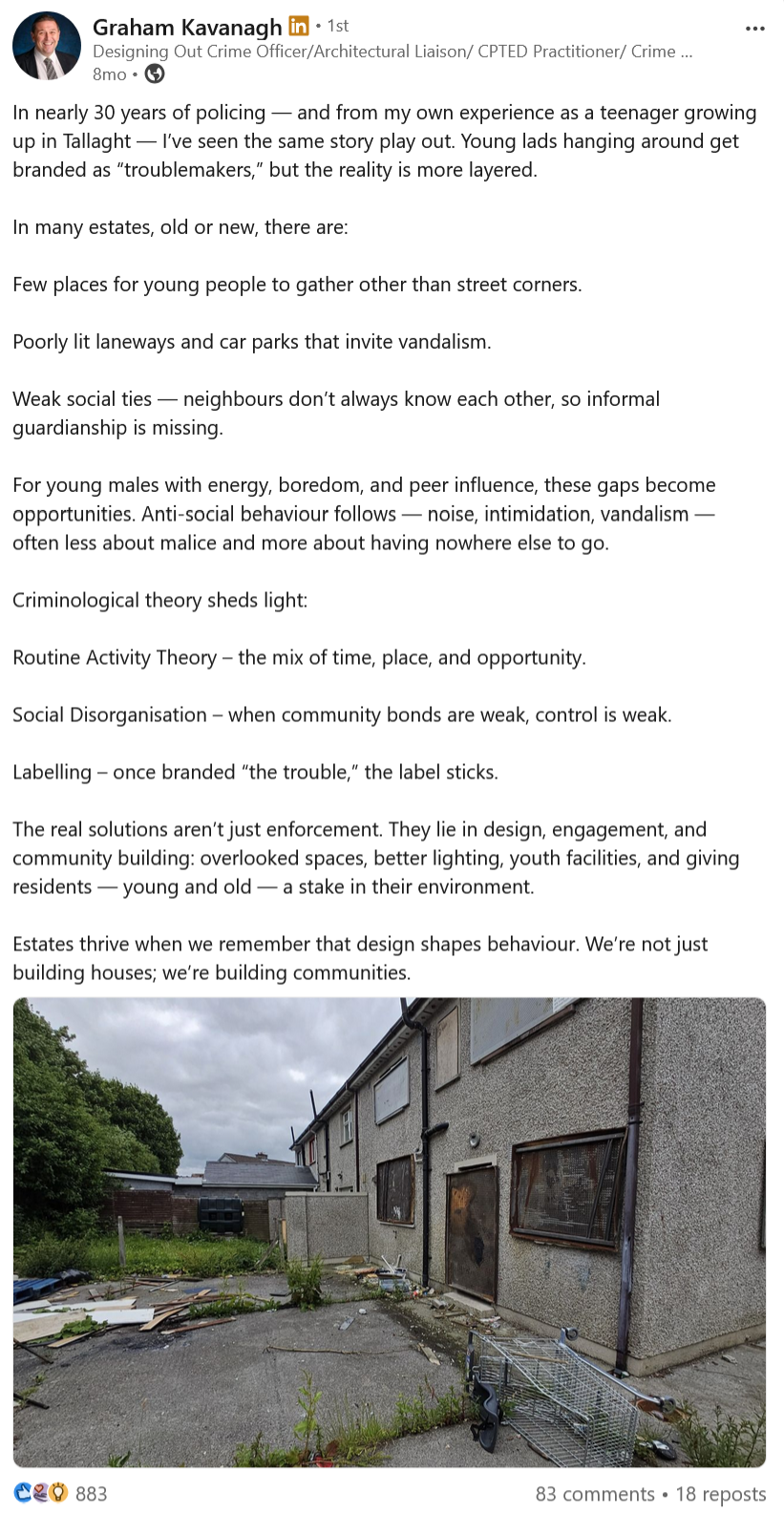
In nearly 30 years of policing — and from my own experience as a teenager growing up in Tallaght — I’ve seen the same story play out. Young lads hanging around get branded as “troublemakers,” but the reality is more layered.
In many estates, old or new, there are:
Few places for young people to gather other than street corners.
Poorly lit laneways and car parks that invite vandalism.
Weak social ties — neighbours don’t always know each other, so informal guardianship is missing.
For young males with energy, boredom, and peer influence, these gaps become opportunities. Anti-social behaviour follows — noise, intimidation, vandalism — often less about malice and more about having nowhere else to go.
Criminological theory sheds light:
Routine Activity Theory – the mix of time, place, and opportunity.
Social Disorganisation – when community bonds are weak, control is weak.
Labelling – once branded “the trouble,” the label sticks.
The real solutions aren’t just enforcement. They lie in design, engagement, and community building: overlooked spaces, better lighting, youth facilities, and giving residents — young and old — a stake in their environment.
Estates thrive when we remember that design shapes behaviour. We’re not just building houses; we’re building communities.
The post references crime prevention through environmental design (CPTED), "a system for developing the built environment to reduce the possibility of opportunistic crime and limit the perception of crime in a given neighborhood." (Wikipedia)
Elements of this kind of design include things like streets designed for pedestrian and bicycle traffic, lighting placed at heights that promote the ability to see faces, and even "maze" style entrances to public restrooms.
But what happens when a disaster wipes all of that away?
Finding the familiar amid the unfamiliar
Earthquakes, wildfires, strong tornadoes, and floodwaters can obliterate not only homes and businesses, but also familiar points of reference like streets and landmarks. It becomes nearly impossible to orient when everything around you is flattened. More so when "everything" includes things you once relied on to navigate.
Following the 9/11 attacks in lower Manhattan, for example, I recall people commenting on how the sheer scale of the fallen towers at Ground Zero boggled their minds. Closer to home, during the immediate aftermath of Hurricane Helene, I remember feeling shocked at the way fallen trees and limbs transformed familiar routes of passage back into wilderness.
Disorientation, I thought, might only fuel a sense of desperation, especially if you were trying to escape a home too unsafe to return to, or to find some kind of food or supply you or a loved one needed and hadn't thought to stock up on.
When the structures and layout we're used to go away, we naturally look to the familiar for comfort: the people we know, the possessions we may or may not be able to take with us... and the illusions we have about ourselves.
In survival mode, we might realize we've focused on the wrong things all along. That we're not prepared for basic survival. That people are depending on us and we're failing them. That we should know better, do better, be better.
These illusions, too, can fuel that sense of desperation. After all, in the days following Helene, generators powering traffic signals needed to be chained to utility poles so they couldn't be stolen. (Whether people were using them or selling them wasn't quite clear.)
Or, the disorientation might have given people a sense of purpose. As it turned out, anyone who possessed and knew how to use a chainsaw proved crucial to our recovery. Civilians cut tree limbs out of driveways and roadways while public works crews were occupied elsewhere. It would be weeks before FEMA could help coordinate contractors to do likewise on private property.
Before resources and continuity come immediacy and creativity
In her book A Paradise Built in Hell, Rebecca Solnit noted, the "resources and continuity" of official relief agencies and volunteer groups take time to mobilize and get set up.
As I learned over two term papers for my first graduate class, that has certainly been the case in the Philippines, many times over in recent history. Following earthquakes, typhoons, and even volcanic eruptions and landslides or lahars, days before the International Red Cross and other organizations were able to get on the ground, volunteers from military outposts and schools, mining operations, and churches provided critical rescue and other aid.
Closer to home, of course, were the "boat brigades" of rescuers who went from house to house across a flooded New Orleans in 2005, rescuing trapped survivors. As survivors gathered at the Superdome and the Convention Center, after it became apparent that help wasn't coming anytime soon, again the people stepped up.
In Episode 3 of the documentary Hurricane Katrina: Race Against Time, survivor and documentarian Shelton Alexander said: "The [Superdome area] started getting real trashy. So, a lot of the teenagers, they started coming together, and they started cleaning up."
Ed Bush, a Louisiana National Guard public affairs officer assigned to the Superdome, recalled: "There was a young man pushing around one of those hotel luggage carts with a person laying on it. And he said, 'Hey, this lady just passed out. What do you want me to do with her?' And she was okay... she was conscious, but she was clearly overheated. And I said, 'Can you roll her to the medical center?'"
The boy did so – then returned about 10 minutes later, said Bush, asking if he was needed to keep transporting people. Bush accepted his offer. "He loved that he had a role," said Bush, adding that the "risk" of allowing the action was minimal – and the result massive. "The impact of other people seeing how he was helping was colossal."
Solnit wrote of numerous similar examples of "resilience, resourcefulness, and public-spiritedness" in New York City later in September 2001. “A couple of young kids, maybe in their teens or maybe their early twenties, tried to help me get the line from under all the debris to get some water on the fires," she quoted one volunteer. "They were just civilians." Another 15 young homeless people became vital members of the teams tending Union Square and the surrounding scene, finally, Solnit observed, able to give back to their community rather than hustle for food.
The book is filled with these kinds of examples, from the community kitchens that sprang up after the 1906 San Francisco earthquake, to the response of teens alongside soldiers and sailors in 1917 Halifax (Nova Scotia) following the explosion of the munitions ship Mont Blanc, to brigades of civilians who tunneled through rubble left by the 1985 earthquake in Mexico City.
It was the kind of engagement Kavanagh wrote about in his LinkedIn post. But I'm loath to say that these were any kind of "legitimate" tasks relative to, say, the "looting" Katrina survivors were said to have engaged in instead – scrounging food and medicine and other supplies their loved ones needed from closed stores.
Reordering the social order
That isn't to say crime doesn't happen after a disaster. But reports of widespread lawlessness in the New Orleans Superdome and Convention Center after Hurricane Katrina turned out to be largely overstated and focused on the wrong people.
One of Solnit's key points in her book is that who she calls "elites and authorities" fear the disruption or even destruction of social order. I've found this fear reflected in state-hosted FEMA courses, where instructors have cautioned against "self deployment" of volunteers who had not, for example, received Community Emergency Response Team (CERT) certification, or were coordinated through a voluntary organization active in disaster (VOAD).
Solnit took the view that "self deployment" irritates officials because “the appearance of these groups suggests the inadequacy of official response efforts." In New York City after 9/11 particularly, she wrote: "The highly functional bottom-up organization of the commissary clashed with the top-down structure of these [official response] organizations."
I'm not so sure it's that reasoning so much as officials' concern for everyone's safety. As my instructors have stressed, untrained and unequipped volunteers are a safety risk to themselves and others, and responders who have to spend time rescuing would-be rescuers then cannot engage in other meaningful response work.
People, though, want to help – their own families if not their broader community. Solnit points to philosopher and psychologist William James, who wrote that in response to calamity, "...human beings respond with initiative, orderliness, and helpfulness; they remain calm; and suffering and loss are transformed when they are shared experiences."
This observation prompted James to propose an alternative to a military draft. Conscripting young people to "the army enlisted against Nature,” James wrote, would provide even privileged youths with an understanding of “man’s relations to the globe he lives on, and to the permanently sour and hard foundations of his higher life" via mining, railroad and street infrastructure building, even dish-, laundry-, and window-washing, "to get the childishness knocked out of them and to come back into society with healthier sympathies and soberer ideas.”
How do you integrate the ostracized?
James' idea, though, focused on privileged youths – not the kids Kavanagh's post reflected, those already ostracized by formal social structures. Yet as Solnit's examples showed, these outcasts can prove to be among the most resourceful.
In the immediate aftermath of disaster, then, CPTED might be less about the physical design of a community (or shelter or tent city) than about its social design: to anticipate self-deployment rather than discourage it, and to try to mitigate its less desirable outcomes.
Certainly, part of this design would be to encourage more members churches, schools, small businesses, and other community anchors to obtain CERT qualifications and sign up through VOADs. These measures would better equip people to respond safely and rationally to emergencies, even if they are limited to their own homes and neighborhoods.
But a disaster-oriented CPTED might head off crime and other antisocial behavior by integrating people's deep knowledge of how individual communities work.
Of New Yorkers, for example, Solnit wrote they "were well served by their everyday practices of walking the city, mingling with strangers, and feeling at home in public... and so the everyday qualities of true urbanism may too be survival skills in crisis."
These qualities are latent in kids with nothing else to do and nowhere else to go, who might just end up observing a neighborhood's regular rhythms and patterns. As such, they could provide valuable intelligence on who has what needs, resources, and other factors in an immediate aftermath.
In other words, people's everyday problem solving might give them a leg up in solving problems during disaster, too – but only if they can be trusted and integrated in the process.
Solnit wrote: "Heroes are necessary because the rest of us are awful—selfish or malicious or boiling over with emotion and utterly unclear on what to do or too frightened to do it." And yet, as all these examples show, people benefit from arguably "everyday heroes," who may not be first responders but nonetheless respond when needed. Sometimes they're trained. Sometimes they're self-taught. And sometimes they just want to lend a helping hand.
"Much in the marketplace urges us toward safety, comfort, and luxury—they can be bought—but purpose and meaning are less commodifiable phenomena, and a quest for them often sends seekers against the current of their society," Solnit wrote. "In a society where immediacy, belonging, and purposefulness are already ubiquitous, a disaster would be only a disaster."