This Semester's (and Summer) Reading List Has Me Mourning, and Marginally Hopeful
Some reads feel like anachronisms, but others offer a different way to approach old assumptions

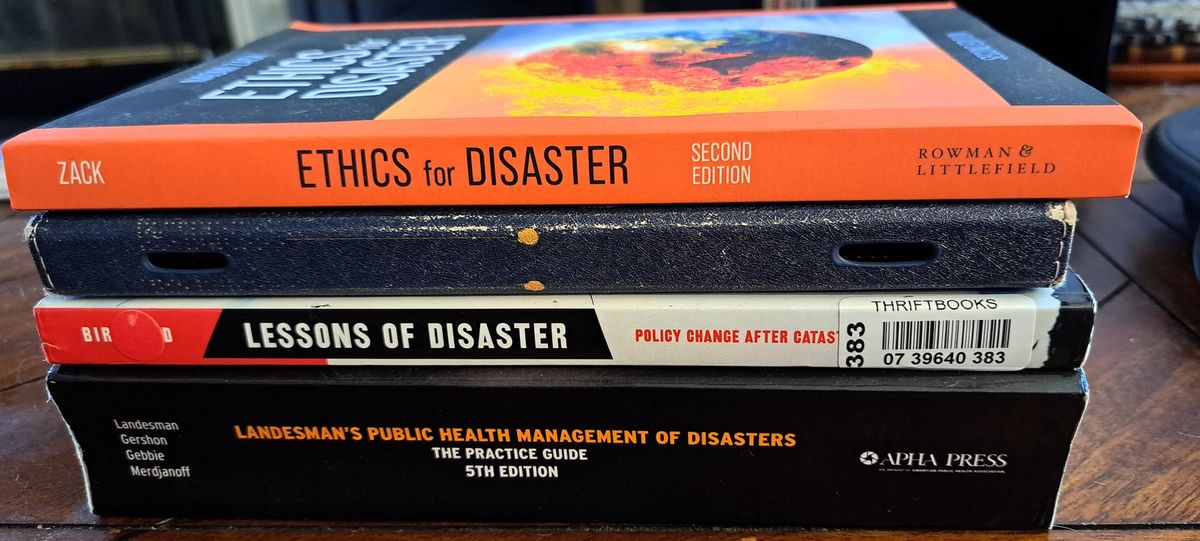
After my first graduate class ended last May, I admit I had a little trouble downshifting. I wanted to stay engaged with my emergency management studies, but I'd exhausted most of the FEMA independent study courses that seemed relevant to me.
After actual years away from the regular reading habit I'd sustained throughout most of my life, I also wanted to maintain the reading habit I'd finally managed to cultivate in the early mornings before work.
I'd scored a couple of textbooks from the office of a manager who had moved on as I was transitioning into my new workplace. She'd completed her MBA before I arrived, and though she cleaned her office out upon her departure, she left many of her books behind. The two I inherited:
- Lessons of Disaster: Policy Change After Catastrophe (Thomas Birkland, 2011)
- Landesman's Public Health Management of Disasters: The Practice Guide, 5th edition (Linda Young Landesman et al., 2021)
(Yes, I'm a nerd. I thought we established that already.)
Books based on bygone assumptions
I started with Birkland's book, which was much shorter although, as it turned out, denser. His focus was on different kinds of policy change following aircraft disasters, terrorism, and to a lesser extent, natural disasters, especially earthquakes versus hurricanes.
Landesman's book was extremely detailed, and in that, even more poignant. Birkland's book had left me wistful for policymakers with enough in common to work together for public good.
In contrast, Landesman's book focused on the structure of public health disaster response – the formalized processes that rely on organizations whose funding and staff have been dramatically reduced in the past two years.
For example, an early mention of the Global Virome Project and the US Agency for International Development (USAID)'s PREDICT program turned out to be moot: both projects ended in 2020, the result of Trump administration funding cuts.
Other programs, like air quality reporting project AirNow.gov and the Centers for Disease Control & Prevention (CDC) Community Assessment for Public Health Emergency Response (CASPER), still appear to be live, though it's unclear whether they are being maintained or can still provide technical assistance.
Meanwhile, the National Institutes of Health, which houses the Disaster Research Response program, intends to launch an entirely new website in forthcoming weeks.
Ultimately, in the five years since the publication of Landesman's most recent edition, a lot has changed. It's a good foundational read, but it also felt like already an anachronism, a relic of a bygone era. Our assumptions are changing along with our funding, the ways we communicate and even think, and of course our climate.
Texts based on more universal concepts
This semester's reading list is more thematic than prescriptive. The list includes:
- The Sphere Handbook for humanitarian relief standards
- Promote the Dog Sitter, a book about disaster leadership by Edward Conley
- Ethics for Disaster 2nd edition (Naomi Zack, 2023) (note: we haven't gotten to this one yet in class)
- Chapter 2 of Prentis Hemphill's What It Takes to Heal (note: we've been encouraged to read the whole book, which I intend to; more on this in a bit)
- Resources like SAMHSA's Concept of Trauma and Guidance for a Trauma-Informed Approach, CDC's Adverse Childhood Experiences (ACEs), and FEMA.gov.
I tend to look at things in aggregate and not just component parts, so what stood out to me about the first class week's readings was the way they came full circle. Conley's first couple of chapters described fundamental principles of leadership; SAMHSA, CDC, and Sphere all described the issues and best practices – arguably the responsibilities Conley wrote about the need to recognize – resulting from much trial and error; then Hemphill underpinned all of it in their discussion of why it matters, mirroring and even personalizing the language in the SAMHSA and CDC documents.
Hemphill's powerful words, in fact, gave me a little bit of hope. Admittedly, reading the Sphere, SAMHSA and CDC resources, I felt that same sense of despair as I did reading Landesman and Birkland: for all the ways these ideas and approaches have been, and continue to be, undermined by people so far removed from their own traumas that they believe controlling others is a way to win.
This idea goes to a point Hemphill made: that trauma makes belonging contingent or dangerous, leading us to seek isolation or supremacy. It does seem to me as if "best practices" assume good faith on practitioners' part, when most days it seems like good faith is a form of quaint naivete.
In other words, I worry that just as "therapy speak" can be weaponized on an individual level, so too could "trauma informed" principles, in the wrong leaders' hands, on an organizational or response level. In fact, a conundrum that came up for me when reading the Sphere handbook is when the "dignity of all persons" extends to deeply traumatized, unhealed people who may perpetrate various forms of abuse under stress.
There was no mention (that I could see, so early on) of the kinds of prosocial supports they and potential victims would need to prevent abuse. In other words, how can we make room for individual and community healing when some people just aren't ready to?
If anything, Conley's and Hemphill's chapters, written at the individual level about what we can do as leaders to support the principles outlined by SAMHSA and Sphere, both highlighted the challenge and risk of becoming trauma informed.
It means we will potentially need to face our own "stuff" – belief systems, patterns, and assumptions – that we think of as "normal" or even universal, "just the way things are" when in reality it is a deeply problematic form of our own inclination toward (or at least, acceptance of) some form of supremacy.
But "normal," as this article points out, still leaves too many people out because it means different things to different people. Thus when we "disaggregate" data, in contrast with "normalizing" it, we make room for individual experiences and effects that are not our own or those of the most powerful and vocal people in a community.
We then become open to learning and thus healing, the kind Hemphill believes can help us build a better world. If they, an author living at the intersection of multiple marginalized identities, can still trust in good faith – not giving in to the rank cynicism we already see so much of – then so can the rest of us.


