Humanitarian Care Has Standards. Who Knew?
How to deliver mass care services without traumatizing the masses


The title for this post is somewhat tongue in cheek. Until this semester of grad school, I literally didn't know that humanitarian care has standards. I bet you didn't, either, unless perhaps you work for a humanitarian organization or have studied extensively in this area.
That's fair, in my opinion. We might read or hear about the shelters and feeding stations and child-friendly spaces the International Federation of the Red Cross and Red Crescent (IFRC) establishes after an earthquake or landslide or flood, and assume they are the result simply of an organized, carefully managed corporate system.
Indeed, media coverage tends to focus on the organizations themselves; the machinery rather than the lubrication that allows it to function smoothly. As a result, we might not realize that organizations like the IFRC would not be able to deliver such consistent care across such a wide variety of countries and disasters without standards.
In part, I think this is because we are used to thinking about standards in very specific contexts. For example, our personal standards for whom we date or hire can be too high or too low. If we work around machinery or hazardous materials, our training should be telling us how to ensure the machinery or our personal protective equipment meets the standards created to protect us. That training came from the standards, too.
We typically don't consider the years of trial and error, the injuries and deaths and resulting hardships, that led to the creation of these standards.
In a humanitarian context, our understanding is opposite. We've almost certainly learned of horrific conditions following disasters, wars, famines, genocides, etc. But we've never learned how humanitarian response works to ensure they don't repeat those conditions.
The standards, and how they came to be
Part of the reading for this semester's class in Trauma Informed Emergency Management is the Sphere Handbook, primarily its opening chapters explaining its Humanitarian Charter and four Protection Principles, along with its nine Commitments to Core Humanitarian Standard on Quality and Accountability (CHS).
The same week I read these chapters, I listened to a Heather Cox Richardson video, in which she described typical conditions within concentration camps. I realized that her description was basically the opposite of what the CHS calls for.
Curious about how Sphere and the CHS came to be, I learned that Sphere was founded in 1997 – shortly, of course, after the humanitarian responses to northern Iraq, Somalia, Bosnia and Herzegovina, Rwanda, Kosovo and East Timor.
That got me thinking about that persistent conspiracy theory around "FEMA concentration camps." I realized that not only sheltering and related services, but also communications about them, would need to embody the CHS to avoid any perception that congregate care could be construed as a "concentration camp."
(Of course, it is impossible to say this and not wonder whether disaster sheltering might, regardless, end up retraumatizing survivors being warehoused in other forms of congregate facilities.)
I was struck ultimately by how democratic the CHS are. They recognize a give and take between responders and recipients of aid.
On the responder side, It's not about responders swooping in and "rescuing" people from a disaster or taking over (colonizing, if you will) their community. Instead, the standards give responders a foundation to understand that they are walking into an entire community with its own culture and individuals who have all happen to have been hit by a disaster, and need some help while they get back on their feet.
On the recipient side, survivors have a responsibility to communicate their needs throughout the process so that responders can honor them.
Overall, the standards communicate that if responders don't honor these factors, it will be harder for survivors to rebound and continue. In the age of remote warfare – particularly when it is used in deliberate targeting of civilian populations to discourage and demoralize warfighters – this emphasis on people rather than technology is nothing short of refreshing.
And yet.
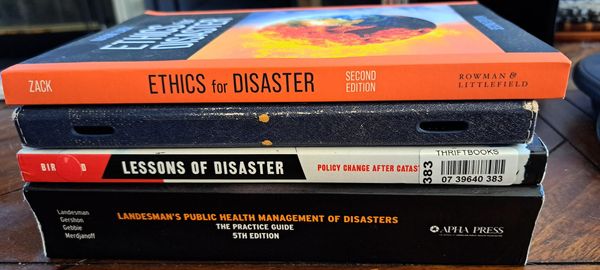
The thought that kept occurring to me, while I was reading Landesman's Public Health Management of Disasters, was that in the best-intentioned approach to offering care for as many people as possible in the shortest period of time, it's possible to make things worse for some – if not many.
I had a similar thought while reading the Sphere Handbook's Guidance Notes for the four Protection Principles. As I reflected in my class discussion:
- The negative coping mechanisms named including transactional sex, early marriage, child labor, and risky migration seemed to focus on mitigating systemic issues such as humanitarian aid processes or punitive laws. To these I would add child abuse and domestic / family violence.
- On that note, though, in the introduction to this handbook, Sphere touted cash based assistance as a way “to meet multi-sector needs as well as sector-specific needs… [and to] address discriminatory practices that restrict women’s access to assets and their decision-making around the management of assets,” but in these notes, mentioned that cash based assistance is subject to “looting.” Not mentioned are abusive dynamics like coercive control in domestic abuse situations, so it’s not clear (unless the handbook covers it in a later chapter) how humanitarian organizations balance the need and benefit of cash based assistance with negative outcomes.
- Likewise the guidance to “Keep families together” without a mention of the potential for abusive dynamics and whether, in disaster or conflict, immediate stability is viewed as more important even if individuals in a family unit are experiencing harm from negative coping mechanisms.
- Regarding the guidance notes about outreach with “hidden” at-risk groups, the fact that they are “hidden” makes them particularly vulnerable, and made me curious about how volunteers are screened not just upon recruitment, but also throughout a deployment, to protect vulnerable people from volunteers with ill intentions.
- Kind of on a similar plane, I’m wondering how far in advance and how aid organizations establish relationships with at-risk groups and organizations these groups trust.
- Finally, as someone who has worked adjacent to information security professionals, I thought the guidance note on sensitive information was interesting because of the tension between the convenience / infrastructure of, say, Google or Starlink versus such companies’ checkered patterns of data practices and philosophies.
Our class discussion included a fellow student's observation about the careful balance between rules and adaptability. Rules limit who can go out and perform humanitarian work, in order to protect the vulnerable from "helpers" with less than noble intentions. But adaptability realizes that in a crisis, maybe women and/or children might not feel comfortable approaching a man. How do they then get assistance they need?
It comes back to communities
Another downside of media coverage that focuses on organizational machinery rather than the lubrication of standards, is that we start to believe organizations should be in charge. We might miss the ways in which we can be useful to any kind of humanitarian response.
In his book Promote the Dog Sitter, Ed Conley refers to former FEMA administrator Craig Fugate’s belief that the public represents an asset rather than a liability, and can be leveraged as “part of the response team.” I've written about this, of course, and even in this context, a balance is necessary, as "self-deployment" can be as risky to responders and survivors as having no help at all.
Conley offered another observation: that after winning office, politicians need to make an individual and collective mental shift from campaigning against the government, to being the government. It's not unlike when, as Conley wrote, “every disaster recovery hits a rough patch after agencies have met immediate needs, and the community begins to confront longer term and more complicated recovery challenges.”
To that end, understanding Core Humanitarian Standards is valuable for all of us at any level of response, whether we volunteer with an organization or are just checking in on our neighbors. We live in an era of bad faith, cynicism, and suspicion – yet continue to need each other.
Thus standards like Sphere's can help us decide how much grace to extend. How can we embody humanitarian action within our own families and communities? How can we communicate our needs to others, particularly elected leaders and helpers, and by what standards can we hold them to account for meeting our needs? When they fall short, how and from whom can we turn to?
The answers, of course, are unique to each of us. I'm personally just at the beginning of finding mine. A lot of people are too stuck in survival mode to think about it – I've been there too. But humanitarian care standards give us a baseline to start.